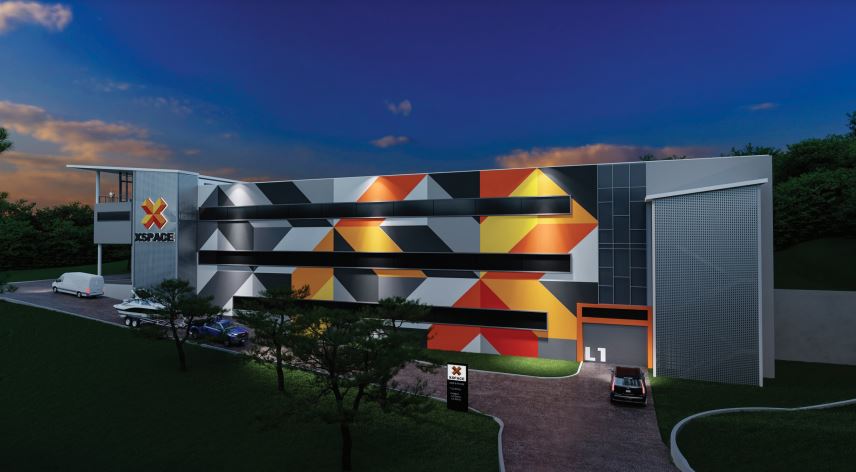
Unique Commercial Condo Concept XSpace Lands in Texas

“It’s an evolution from traditional development”

The story has reached a level of infamy at this point, but it bears repeating. The weekend after Thanksgiving, Byron Smith sat at a Houston restaurant with a margarita in his hand.

“I was in a strip mall, but looking out, I saw a church, a school next to it,
an ugly office building and then a strip club,” he laughs. “I just thought, ‘Well, that’s a bit on the nose, isn’t it?’” Smith and his business partner Tim Manson had been looking for a market to expand their Australian-based XSpace concept.

“Until now, you were either in an office building or a warehouse or self-storage,” says Smith. “We thought there had to be an innovative way to
reimagine how people can use and think about space.”

The result is XSpace, which blurs the lines between commercial and creative space. Success in Australia helped the partners see the gap in the market in America.

“It’s an evolution from traditional commercial development,” Smith says. Click to read more at www.rednews.com.

Emerging Trends in Real Estate Report

Commercial Real Estate Enters its “New Normal” Period

A new normal. That’s what the COVID-19 pandemic has brought to the commercial real estate market, especially in the office and retail sectors.

That’s the conclusion from the Emerging Trends in Real Estate 2023 report from the Urban Land Institute and PwC US. This report, released each year, includes proprietary data and insights from more than 2,000 real estate industry experts. And this year’s edition — in little surprise — focuses on the way the commercial real estate industry has evolved since the onset of the COVID-19 pandemic in 2020.

The report also looks at the more recent headwinds facing the commercial real estate industry, rising inflation rates and persistently high inflation. These two factors are already having an impact on the demand that investors have for commercial assets.

Midwest Real Estate News spoke with Byron Carlock, real estate leader for PwC US, about the report and its findings. Here is some of what this industry expert with more than 28 years of experience in the industry had to say.

Let’s start with the hot topic of the day: What impact are rising interest rates having on commercial real estate deals?

Byron Carlock: Interest rates today are two-and-a-half to three times higher than what people might have been seeing when they began their underwriting on construction projects or acquisitions. The constriction that these higher rates have had on the capital markets is very clear. There is still some funding out there, but at lower loan-to-cost ratios. More deals are going to the non-bank funds that are standing on deck waiting for the deals that traditional banks are now passing on.

Commercial real estate transaction volume has fallen dramatically in the last 60 days. The question now is how much will the industry readjust to these higher rates?

Have the interest rate hikes been too sudden? Would it have been better for the Fed to raise its rate at a more gradual pace?

Carlock: The Fed wanted to send a signal very quickly to help reduce asset inflation. There is talk about how a healthy economy might have a 5% to 6% unemployment rate. We are now at 3.5%. This rapid escalation of the Fed’s rate, then, was designed to let some air out to the tires of this economy very quickly. Sadly, it has. What is interesting to me, though, is that the demand for certain product types is still very healthy. Multifamily housing, especially, is still in high demand. We are still an under-housed society. The developers that are trying to meet the need this country has for new housing were caught flat-footed by these interest-rate hikes. Their deals might no longer meet underwriting criteria.

Given the uncertainty of the economy, do investors still view commercial real estate as a good investment?

Carlock: Real estate has always been viewed as a safe haven in times of inflation. Those who can increase their allocations in real estate seem to be wanting to do so. Those who are not able to do so are hampered by the denominator effect. Their valuation doesn’t get them to the margins they need to get to other assets such as real estate. But in general, people do still view real estate as a good investment. In today’s market, some of the alternative assets such as data centers, life sciences facilities and self-storage facilities are seeing great competition from investors.

There is still great concern, though, about the office sector. The post-pandemic reality is that owners have to redesign spaces to inspire people to want to come back to the office, to make it an enjoyable as opposed to obligatory experience. Building owners are redesigning office spaces for this new normal. Today, it’s about going to the office for collaboration, planning, mentoring and training, not to do the head-down work in a cubicle.

Are more office tenants seeking Class-A space to inspire their workers to come back to the office?

Carlock: That is one of the big changes coming out of the pandemic, the rising demand for Class-A-plus office space. The rates people are willing to pay for that higher class of building are very impressive. But what happens to the lower-class office space? There is a lot of talk about converting these spaces to alternative uses. Some cities are offering incentives to encourage these conversions. They might need more multifamily housing, so they are encouraging owners to convert their obsolete office buildings into apartments.

This will force some hard decisions about our existing office space. The downtown buildings with large floor plates built from the ‘60s to the ‘80s might need a change. That’s significant because about 80% of our office stock was built in the ‘80s or before. We will see a great change in which office space is relevant and which is not.

Are you seeing more apartment renters moving to the suburbs following the pandemic?

Carlock: There is evidence that the pandemic did reopen the suburbs after years of us talking about the suburbs being dead. There’s a big difference when the commute to the city for work is now two or three days a week instead of five. During the pandemic, we saw tremendous numbers of people moving further out from the city as they gained permission to work remotely. Apartment rents in most of the gateway cities are at or above their pre-pandemic levels. People are moving to the suburbs to get some relief from that. The move to the suburbs is a comment on affordability and the flexibility that comes from working remotely.

Are more companies moving their office spaces to less expensive but still large cities now that so many of their employees are working remotely.

Carlock: We have seen more migration southward. People have chosen to move to business-friendly environments with relative affordability and easy access to a talent base. They are moving to cities like Nashville, Austin, Dallas and Phoenix. We can’t ignore the attractiveness of business-friendly, low-income-tax states like Texas and Tennessee.

Just look at Nashville. It’s hard to go there and not say, ‘My goodness. I can see myself living here.’ It’s a business-friendly environment. There are talented workers available. Some of the financial services businesses that have moved to Nashville from New York thought that they might have a hard time persuading their New York City workers to move to Nashville. But it turns out that those workers love living in Nashville.

This issue of mobility and the attractiveness of cities and states is something worth noting for cities struggling to keep their businesses. Just look at the corporate relocations and exodus we’ve seen in Chicago. Some of these cities that are losing businesses might need to move away from the tax-and-spend policies they’ve relied on in the past.

What should cities do today to keep not only their businesses but to inspire people to want to move to their multifamily properties?

Carlock: Can we re-imagine our cities? As polarized as we get in this country about political and social issues, we can all agree on the importance of art, green space, gathering spaces and music. Our major city cores continue to offer all of that. You can’t recreate the depth of culture that has been developed during 100 years or more in our cities. If we could move away from the political polarization to think about making our cities better and more attractive for people, that could make a major difference in our country.

That’s a lofty goal, but it is doable. There is an emotional draw to the urban core. History has taught us that. Just look at Chicago. It has such wonderful architecture and culture. If we could solve some of the big problems cities face and focus on the culture and beauty that they provide, we can make a dramatic improvement in our country’s health. We need to find a way to improve the collaboration between public and private funding to do greater things to reimagine our cities.

Sale of Newly Completed Industrial Building in Northeast Dallas Closes

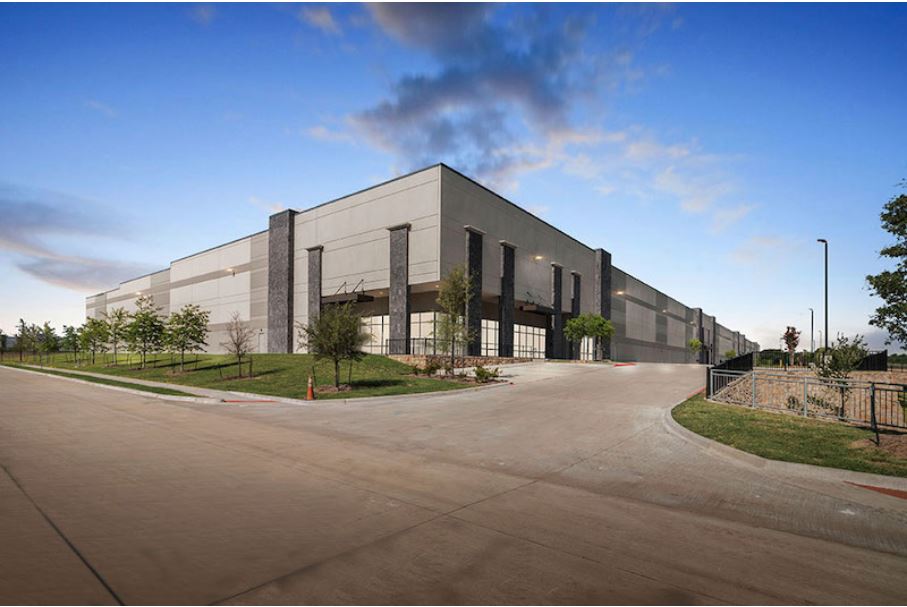
JLL Capital Markets announced today that it has closed the sale of the Logistics Center at McKinney Building B, a Class-A, 301,796-square-foot industrial building in McKinney, Texas.

JLL represented the seller, a joint venture between Thor Equities Group and Morgan Stanley, in the sale to AC Industrial Properties LLC.

Logistics Center at McKinney Building B is a rear-load building featuring 32-foot clear heights, 130-foot truck court, 52 overhead doors, two drive-in doors and 190 parking spaces.

The property is situated on 16.82 acres at 350 Cypress Hill Drive with direct access to Dallas-Fort Worth and Texas’s major commercial hubs via U.S. 75, Highway 380 and State Highway 121. As a result, Logistics Center at McKinney Building B is within 20 miles of 1.46 million residents. Furthermore, the building is located five miles from McKinney National Airport.

Logistics Center at McKinney Building B benefits from its position in the Northeast Dallas Industrial submarket, which accounts for approximately 20% of the submarket’s total inventory. Vacancy within the submarket is now below the market average. Most new development is occurring in the outlying areas of the submarket, such as McKinney and Frisco. Last-mile tenants are relocating to these fast-growing suburbs following the population growth that has occurred over the past two decades.

The JLL Capital Markets Industrial team representing the seller was led by Senior Managing Directors Dustin Volz and Stephen Bailey, Directors Dom Espinosa and Zach Riebe and Analyst Pauli Kerr.

Decarbonization 2022: The Role of Commercial Real Estate

Decarbonization is commonly defined as the state in which the amount of greenhouse gases going into the atmosphere is balanced by the amount taken out. The term is significant, particularly for carbon-dioxide emissions, because it describes the state at which global warming stops.

While many equate climate change with rising temperatures, the story is much more complex. Because our world is an interconnected series of systems, changes in one area have reverberating effects elsewhere. The consequences of climate change can now be seen around the globe in the form of intense droughts, rampant wildfires, flooding, rising sea levels, severe storms, melting polar ice caps and a negative impact on biological ecosystems.

The very nature of this crisis demands action by us all, but particularly those in the building industry which, by some measures, accounts for almost 40% of global energy-related carbon emissions. For building owners, operators, contractors and real estate professionals, this is the time to live the phrase “think globally, act locally.”

Commercial real estate: Part of the problem/part of the solution

As previously noted, the construction and operation of buildings is a significant contributor to global greenhouse gas emissions. The good news is there are many technical solutions available to help decarbonize this sector. The bad news is significant barriers persist that make investing in and financing these efforts difficult.

The World Economic Forum is addressing this challenge by helping the financial services industry redefine how the value of such investments are perceived and defined. The Net Zero Carbon Cities program was launched to consider the social, environmental and system performance outcomes of improved buildings, in addition to traditional financial measures.

Reaching consensus: Standards and goals

Commercial real estate developers are working with local governments to set these sustainability and net zero targets. However, the continued lack of consensus on exactly what “net zero” means makes this type of planning a challenge.

Progress is being made by the International Organization for Standardization in defining the world’s first consensus-based net zero guiding principles and the benchmark for the climate agenda. The organization recently announced the launch of the International Workshop Agreement (IWA) to help accelerate the development of net-zero guiding principles. The initiative hopes to solve a tricky conundrum: How do you translate the science-based concept of net zero into specific, actionable rules and guidelines?

Until a consensus is adopted, companies and developers can follow guidelines suggested by the Science Based Targets initiative (SBTi). The SBTi is described by the organization as “the gold standard for net-zero target setting, which is vital in enabling companies to identify and reduce their emissions and limit temperature rise to 1.5°C.” That is the limit most scientists agree must be achieved by 2050 to avoid the worst effects of climate change.

SBTi released its 2021 Progress Report that indicates the initiative doubled the number of new companies setting and committing to net zero targets. The report also showed a tripling of the rate at which these targets were validated. The organization reports more than 2,200 companies representing ore than one-third of the global economy’s market capitalization were working with SBTi in establishing net zero emissions goals.

The Intergovernmental Panel on Climate Change (IPCC) also recently issued a special report, Climate Change 2022: Mitigation of Climate Change. The news there is a bit more dire. According to the report, “unless there are immediate and deep greenhouse gas emission reductions across all sectors, 1.5°C is beyond reach.” The report outlines how emissions can be reduced by half in key sectors and outlines how humanity can improve its chances for success.

It is clear that the need for universal guidelines is pressing. According to analysis by the Energy & Climate Intelligence Unit (ECIU), while some producers of greenhouse gases have committed to clearly defined and binding net zero plans, others may be gaming the system. Without clear, agreed-upon standards and processes, some entities may be vacuous promises. For example, not making changes in the near term but setting future goals based on the assumption that new carbon capture technologies will become available down the road.

This initiative offers compliance options for LEED Platinum and net zero building certifications.

Acting locally: Industry professionals drive change

Waiting for sustainability requirements to be defined is not an option. There are meaningful actions businesses can take to create net zero plans in the interim:

Tackle energy reduction (i.e., operational carbon) first, before investing in offsets.

Address embodied carbon when constructing new real estate

Review opportunities to electrify (i.e., decarbonize) equipment when performing end-of-life system replacements.

Capitalize on existing local utility incentives and federal tax programs to help fund initiatives.

As organizations move forward with net-zero and decarbonization plans, and adjust them as future regulation comes about, I recommend initially tying targets to the Paris Agreement as this will likely be the sticking point for all climate change initiates and directives to come.

With major cities like San Francisco setting the pace, the rest of the nation seems to be joining the effort for a cleaner, more efficient built environment. For these net zero efforts to be successful, it will require the cooperation of building owners, operators and occupants to work together to meet these challenges while the engineering design and construction industries continue to push for a greener future.

Saagar Patel, PE, LEED AP BD+C, WELL AP, CCP, is the Operations Director for ESD, a global engineering firm specializing in mechanical, electrical, plumbing, fire protection, life safety, structural and technology engineering. He leads ESD’s Sustainability and Healthy Buildings group.

Hartman’s Marketing Team Secures 3 Marcom Awards in Creative Competition

November 3, 2022 (Houston, TX)—The Marcom Awards, a global creative competition administered by the Association of Marketing and Communications Professionals (AMCP), announced three submissions by the marketing team at Hartman Income REIT Management, Inc. (Hartman), as Gold Award and honorable mention winners, for outstanding achievements in video and print marketing.

Each year, honorable mentions and gold awards are presented to a select few of the competition’s more than 6,000 applicants from over 43 countries and selected from 300 categories in print, web, video, and strategic communications. Entries receiving scores between 90-100 points are platinum winners, between 80-89 points are gold winners and between 70-79 receive an honorable mention. As one of the oldest creative competitions in the world, winning a highly sought-after Marcom award from the AMCP is well respected by all peers and communities in the marketing industry. Hartman’s marketing team was recognized for its commercial real estate leasing FAQ video, CRE insights playlist, and a whitepaper on investing in real estate during times of economic inflation.

Award winners are chosen by Marcom judges who seek out nominations of companies and individuals whose talent exceeds a top-tier standard of excellence. Hartman’s marketing team, led by Vice President of Marketing, Anthony Trollope, symbolizes both the established and upcoming talent in the marketing and communications world. The Hartman team is made up of contributions from Malori Bizzell-Johannes, Sarah Hoopes, Lace Llanora, Erik Cordero, and Judith Roque, each bringing to the award-winning team unique perspectives and focused skill sets.

Commenting on the award, Trollope shared, “receiving the prestigious recognition from our peers for the creativity we pour into our marketing is a humbling validation and a prideful moment for our team.” To learn more about Hartman or view the Hartman marketing team’s winning content, please visit www.hi-reit.com.

#

About Hartman:

Hartman is a premier property management company in the Houston, Dallas, and San Antonio markets with more than 59 properties totaling over eight million square feet. Hartman has owned and operated commercial office properties since 1983, offering premium office space at attractive rates for 38 years. For more information, visit www.hi-reit.com.

Contact:
Anthony Trollope
VP of Marketing
Hartman Income REIT Management, Inc.
713.467-2222
press@hi-reit.com

Texas Rangers, Cordish Cos and Arlington Celebrate Groundbreaking of Luxury Residential Community

Slated to open in 2024, One Rangers Way will create an exciting first opportunity to live steps away from Globe Life Field, Choctaw Stadium
and AT&T Stadium

State-of-the-art residential building will offer an upscale living experience with over 43,000 SF of amenities and services on par with the finest residential and condo buildings in the country.

Interested renters can visit www.OneRangersWay.com or email info@onerangersway.com for more information

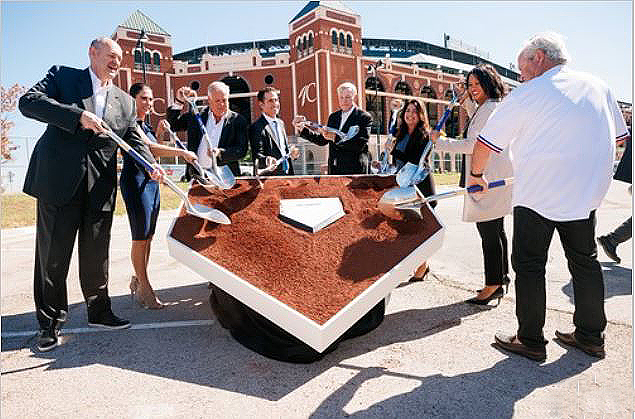
ARLINGTON, Texas, Oct. 27, 2022 /PRNewswire/ — The Texas Rangers and The Cordish Companies gathered yesterday to celebrate the groundbreaking of One Rangers Way, a luxury residential community in the heart of the Arlington Entertainment District. The Rangers and Cordish were joined by Arlington Mayor Jim Ross, Arlington City Council, and community and business leaders from the City of Arlington and Tarrant County to recognize this exciting milestone. One Rangers Way continues the incredible momentum of new development in the Entertainment District that began with the opening of Texas Live! in 2018. The project continues the next phase of over $1 billion of new development currently under construction in the Entertainment District that includes the forthcoming Loews Arlington Hotel & Convention Center, National Medal of Honor Museum and Spark Coworking. Click to read at www.prnewswire.com.